
The Young Firms Rethinking Social Media
Social media has long been dominated by a few companies, led by Facebook. But a number of social-networking startups have emerged on the scene that hope to gain traction by focusing on how young people like to communicate.
The world of social media is dominated by companies like Facebook, Snapchat and Twitter, but that hasn’t stopped a new breed of startups from trying to carve out markets where they think the sector’s giants have fallen short.
These emerging social media firms, four of which we profile below in our latest installment of Startups to Watch, include a business recently launched by two former Facebook employees and another that is capitalizing on the rising trend of wireless headphones. While these founders know they face long odds jumping into a market where a few players command most of the attention, they all are aiming to establish themselves by emphasizing features that might attract younger users.
The Takeaway
Powered by Deep Research
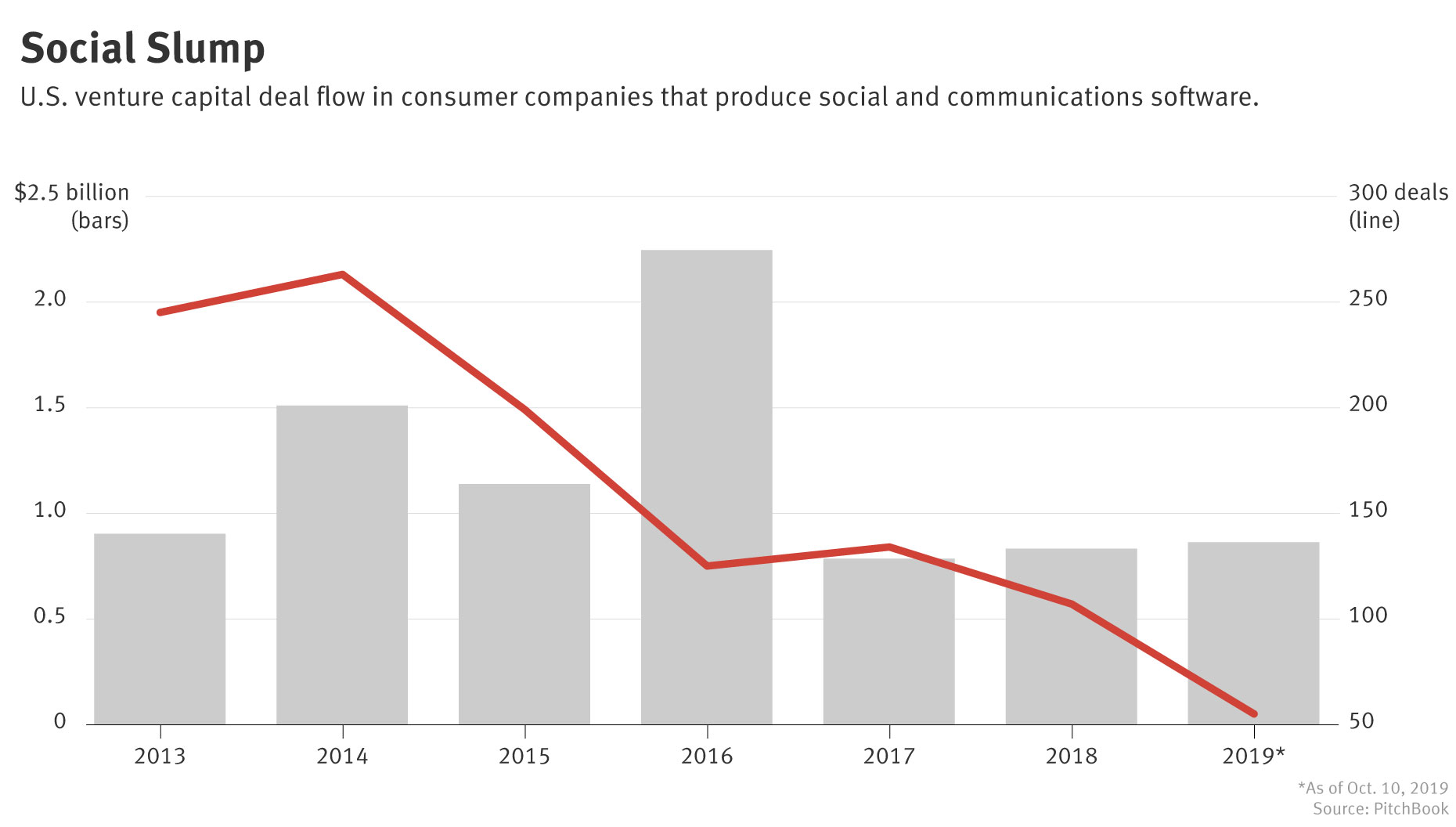
New entrants to the social media sector might not have an easy time raising money, largely because of Facebook’s dominant market share. There were only 107 venture capital deals in U.S. social and communication software companies in 2018, down 44% from 245 deals in 2013—the year Snapchat raised its Series A round, according to data that the research firm PitchBook prepared for The Information.
“It’s rough out there for a social founder,” said Ben Rubin, founder of the live video apps Houseparty and Meerkat, who now is an entrepreneur in residence at Benchmark. “Markets always go through periods where they centralize and they decentralize. Right now we’re in this concentration era.”
Despite the slowdown in deals, investors said promising startups get noticed. One reason is the growing scrutiny of Facebook by regulators, including multiple antitrust investigations in the U.S. Pressure on Facebook to not abuse its dominant market position could give more startups the opportunity to grow without the threat that Facebook might develop similar products, said Niko Bonatsos, managing director of General Catalyst.
“The next Facebook isn’t going to look like Facebook,” said Bonatsos. “Also, Facebook can’t continue to acquire itself to success for anything that looks, feels or sounds like a social network for antitrust reasons. It can of course continue to copy others that seem to have escape velocity.”
To narrow things down, we focused on companies making mobile software that is primarily social and communications-based, rather than those that are driven by passive media consumption. None of the four companies has raised money beyond a seed round. While all of them are growing, they all still have relatively small user bases and have yet to make money from their apps.
Company: TTYL
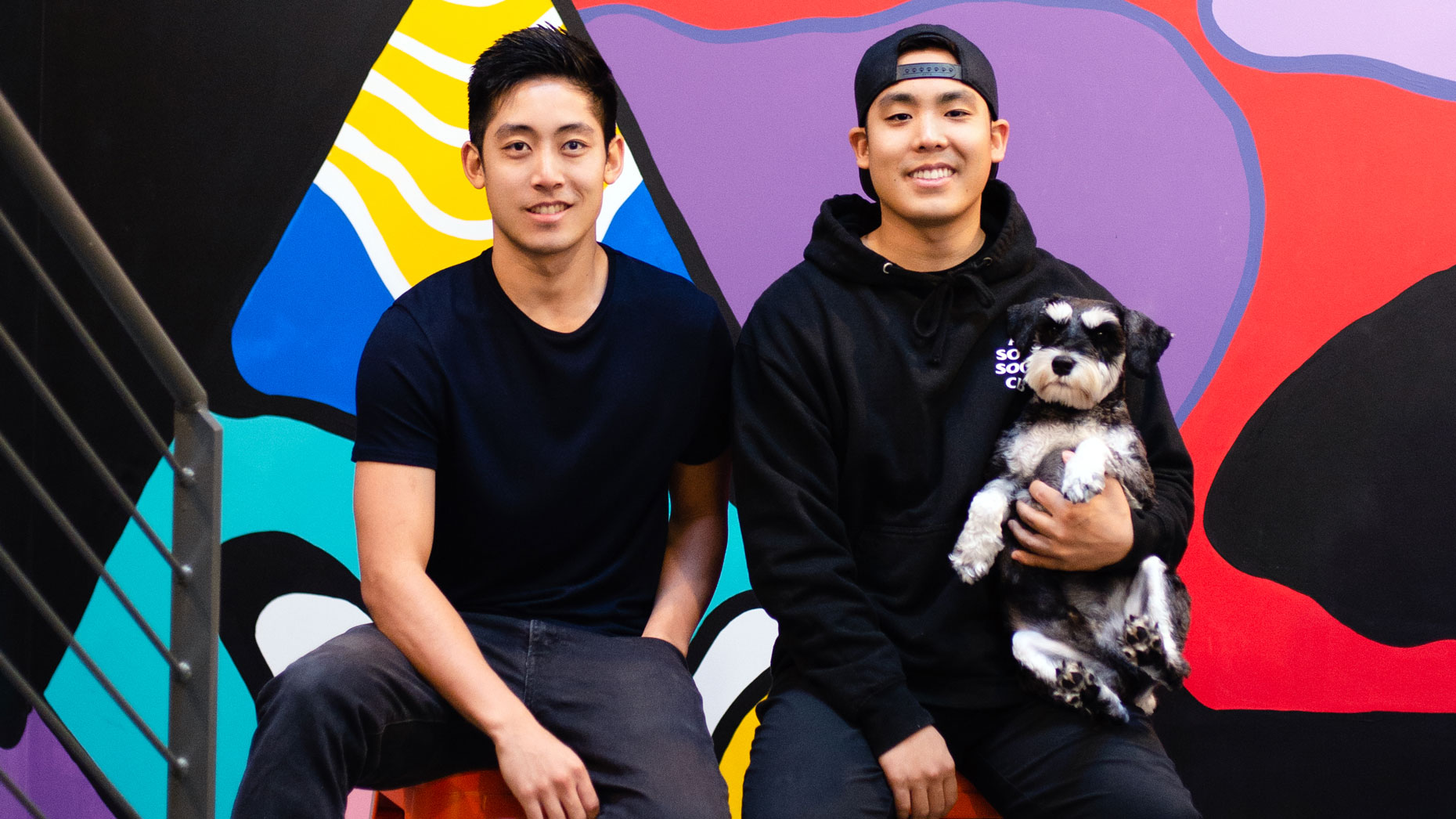
Founders: Alex Ma, Austen Ma
Money raised: $2 million
Investors: Floodgate Fund, SV Angel, Weekend Fund, Shrug Capital
Why it made the list: Despite the rising trend of people wearing Apple’s AirPods and other wireless headphones, TTYL is one of the few social startups seeking to capitalize on the behavior.
TTYL makes an iPhone app that aims to change how people talk to each other over the phone. The app notifies people who are wearing headphones when their friends are also active in the app, giving them the ability to instantly drop into an audio call.
The idea was born after TTYL co-founder Alex Ma graduated from UCLA in 2015, and he quickly discovered he was having difficulty keeping up with friends from school.
“I started to feel like I was losing touch with my friends, even though we were texting every day,” he told The Information. So he started calling them randomly, and realized that “how we get into phone calls just hasn’t changed since the landline.”
Along with his brother and co-founder, Austen Ma, Alex set out roughly a year ago to create the company, with the mission to “build a place where people can feel present with their friends and family when they’re physically apart.” After the LA-based duo raised a $2 million seed round from investors that included Floodgate Fund and SV Angel, they created the first iteration of the app earlier this year.
Making phone calls is “a very, very broken product for millennials and Gen Z,” according to Ma, 26. “If you look at the contrast between millennials and Gen Z, and then just how culturally different we are [from older generations], I think this is a huge opportunity for a new social platform to come up.”
TTYL uses Snapchat’s nascent developer platform to authenticate new users and let them add custom Bitmoji avatars to their profiles, a move Ma said made sense given the user overlap between TTYL’s younger target demographic and Snapchat’s. He said the fact that Snapchat collects little user data aligns with TTYL’s mission to not make money through gathering personal information.
Instead, Ma is interested in eventually generating revenue through optional in-app purchases or even selling physical merchandise. There are no plans to introduce ads into the app. For now, TTYL is focused on acquiring new users. One technique: outreach to high school students through tech and entrepreneur clubs.

Company: Squad
Founders: Esther Crawford, Ethan Sutin
Money raised: $5 million
Investors: First Round, Alpha Bridge, Y Combinator, BBG Ventures
Why it made the list: Recent advancements in Apple’s software for iPhones give developers the ability to easily capture what is happening on a user’s screen, functionality that Squad is using to accomplish its stated mission of “tackling loneliness.”
Early in the summer of 2018, Esther Crawford and her colleagues at their social media startup were coming off a failed social polling app called Molly, when Crawford’s then-13-year-old daughter started complaining that she couldn’t see what her friend was doing on her phone’s screen while the two of them were talking on the phone.
Crawford, who is Squad’s CEO, and her co-founder, Ethan Sutin, set out to create Squad, which lets users show what is happening on their iPhone screen in real time while they are video chatting. Fresh off a recent seed funding round of $5 million led by First Round, San Francisco–based Squad is working on the next version of the app, which Crawford said will include new functionality to let users discover new friends. For now, Squad relies on scanning users’ contacts list to suggest new friends. Like TTYL, the app uses Snapchat’s developer platform for quick user authentication.
In its current iteration, Squad has seen 200 million minutes spent on calls inside the app in 10 months of availability. Roughly 70% of Squad’s users are between the ages of 13 and 22, and heavily based outside the U.S., thanks to distribution through WhatsApp groups, according to Crawford. As for the business model, Squad doesn’t plan to make money through ads or collecting user data.
“We’re not interested in an ad-based model,” said Crawford. “We think that the gaming model is much more interesting, where you have micro-transactions and micro-subscriptions. It aligns users with product development in a much better way. Because we want to build little things that you will actually pay for.”
Company: YOLO
Founder: Gregoire Henrion, Clement Raffenoux
Money raised: $2.5 million
Investors: A Capital, Bridgewater Capital, SV Angel, Weekend Fund
Why it made the list: Those who work and invest in the social media sector took notice about five months ago when YOLO, an anonymous Q&A app, rocketed to the top of the App Store’s charts overnight. Now the startup is working to make an anonymous social network for young people, an area in which past similar apps like YikYak have failed to retain users.
YOLO was the first to successfully leverage Snapchat to dramatically grow its user base and accrue millions of downloads, by letting users pose anonymous questions through their Snapchat Stories. The founder of YOLO, Gregoire Henrion, previously ran a music video app in the vein of TikTok, called Mindie, that failed to gain traction several years ago.
After a stint building software in the restaurant industry, Henrion and his colleagues built YOLO over a weekend. Within a week, the app was No. 1 in the App Store. A seed investment of $2.5 million led by A Capital was closed soon after.
For YOLO’s next act, the app won’t merely be a springboard into Snapchat. An update that has started rolling out to some users includes anonymous, interest-based group chats for users who are, for example, part of the same high school. The catch is that by leveraging Snapchat’s Bitmoji avatars, users are somewhat identifiable by their digital avatars, rather than their actual names. That adds a layer of real identity to the app that past anonymous apps like Yik Yak and Secret lacked.
Given the anonymous nature of the app, YOLO is taking an aggressive approach to content moderation. The startup is using an outside company that scans messages for hateful words before they are sent using artificial intelligence. Roughly 10% of sent messages wind up not being delivered, often because they contain offensive content, according to Henrion. “The challenge with anonymity is to create a healthy community, and we are doing that,” he said.

Founders: Sachin Monga, Alex Cornell
Money raised: $3 million
Investors: Y Combinator, Lerer Hippeau, Susa, Norwest
Why it made the list: While most social networks encourage users to connect with as many people as possible, Cocoon is taking a decidedly different approach by focusing on users’ closest relationships. Run by two former Facebook employees, the new startup recently closed a $3 million seed round to build their first app.
At Facebook, Sachin Monga worked on growth and various product teams at Facebook, while co-founder Alex Cornell led design for Facebook’s live video product. While Cocoon has yet to release its app publicly, Sachin described what they are working on as a digital space for close friends and family. Although the app is still in its early stages, it’s an idea that seems inspired by earlier social apps like Path, which only allow users to add a limited number of friends to keep the experience more intimate.
As part of their research, Sachin and Cornell have been studying the design of physical spaces, like living rooms, and how people interact in those spaces. The founders also are exploring how people use social apps. One influence Sachin cited was “Neko Atsume,” the hit Japanese mobile game in which users can only progress by not actively playing the game for periods of time—an example of how to design software that doesn’t seek primarily to maximize app engagement.
The rise of broadcast-based social media such as Twitter, where users post to a wide array of friends, acquaintances and even strangers, has left room for new social products that focus on people’s closest relationships, according to Sachin. “We have a lot of latent desires that I think just, given the way everything shook out over the last 10 years, has sort of been left behind a little bit,” he said.