
Revenue From AI Coding Tools Surpasses $3.1 Billion
 Art by Getty Images/Mike Sullivan
There’s been a lot of talk that AI tools have yet to prove their worth. But if revenue is anything to go by, there's one area where AI tools have undoubtedly provided real returns: software engineering.
The collective revenue generated from AI coding tools like Anysphere’s Cursor and Anthropic’s Claude Code has surpassed $3.1 billion. This includes nearly $400 million in annualized revenue being generated from Cognition’s Devin coding agent, a number that hasn’t been previously reported, according to a person with direct knowledge of Cognition’s financials. (It doesn’t include OpenAI’s Codex, whose revenue isn’t available, so the total is surely higher than $3.1 billion).
To be fair, $3 billion is still a small chunk of the $150 billion-plus that software engineers globally are estimated to be paid. But let’s not forget, none of these tools existed three years ago. And that figure is rapidly growing. Anysphere’s annualized revenue, for instance, has increased to more than $1 billion from $200 million in March. Meanwhile, since Cognition acquired coding tool Windsurf this summer, its annualized revenue is up more than 150%.
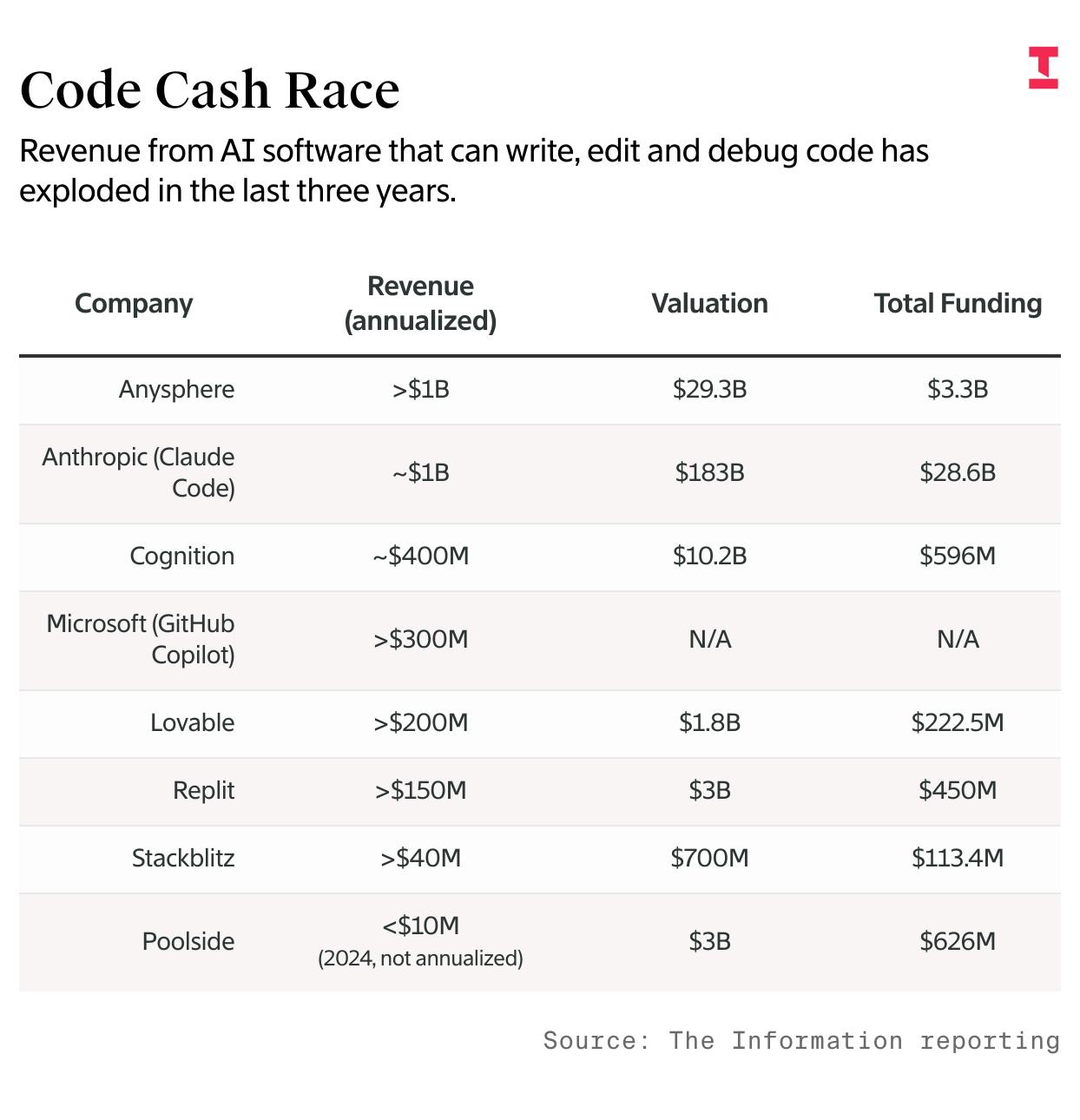
AI coding makes up the vast majority of revenue being generated from the “AI native” startups—not counting OpenAI and Anthropic—that The Information tracks. We define “AI native” startups as those whose applications for professionals or businesses either emerged following the launch of ChatGPT or barely existed until that point.
And we’re likely in the very early days of AI coding as a business. The startups developing these tools and their underlying models have been working hard on getting AI to be able to focus on longer-duration tasks that might take hours or even days. If they succeed, the tools would be more viable as a replacement for expensive engineering labor, rather than being the simple productivity tools for existing employees as they are now. That would ensure businesses would be more likely to pay more for tools.
Already, we can see a number of coding startups like Anysphere leaning into this strategy by adding such “agentic” coding features to their product catalog.
Coding has clearly proven to be a fruitful market for conversational AI technology—now we just have to see whether developers can replicate this success in other domains, like sales, data analytics and finance.
Here’s what else is going on…
ChatGPT Goes Shopping (Again)
OpenAI unveiled a new shopping research tool Monday, reflecting the company’s continued efforts to make ChatGPT into a go-to destination for online shopping. The new feature is now available for no charge to users who have signed up for an account—whether on the free tier or paid.
The inspiration came from ChatGPT “power users” who were already using OpenAI’s existing Deep Research tool for shopping-related tasks, OpenAI executives said at an event previewing the launch last week. The feature is powered by a new GPT-5 mini model that the company says is its best-performing model thus far for product accuracy.
The new tool isn’t meant for every type of shopping question. Instead, it’s designed for someone looking to compare different products or weigh the pros and cons of one product versus another. To use it, people have to select shopping research mode in ChatGPT before they submit their initial query.
One of the most interesting features of Shopping Research is the way it collects user feedback along the way to help steer the model’s answers. As the model is running a user’s main query, it asks for more specific details about what they’re looking for through quiz-like questions. For example, a shopper looking for a new work backpack can tell ChatGPT what size of laptop they have that needs to fit in the bag, or someone searching for a dress to wear to a wedding can tell the feature to show more or less options like a certain style so that the options the feature presents in its final answer are more likely to be useful. The feature summarizes its findings in “buyer’s guides” that lay out the pros and cons of each option.
Both the underlying model and the brief quiz to vet potential options make for one of the best shopping features I’ve encountered from an AI company so far, though Shopping Research definitely needs some guidance. For instance, a search for a duplicate of a Prada designer bag yielded initial suggestions that didn’t look like any Prada bag I’ve seen—even though the merchant labelled them “designer lookalike.” But after I said I didn’t like the suggestions, ChatGPT eventually found some better options.
And its suggestions for a long dress under $300 to wear to a wedding in Italy next spring—a somehow complicated query for many other AI-powered shopping- and retail-specific search startups that have launched recently—weren’t bad.
Since the feature’s recommendations are primarily text-based, brands that have already invested heavily in search-engine optimization (or that have taken an interest in trying to optimize for AI search) appear to have an early upper hand. Brands like Quince, which has invested heavily in SEO and search marketing, appeared frequently in search results. And while OpenAI executives said the feature is meant to help users find items or brands they wouldn’t have come across otherwise, answers usually defaulted to well-known brands with thousands of reviews like J.Crew, Lands End and Everlane.
The feature isn’t yet connected to ChatGPT’s other e-commerce features like in-chat checkout, and OpenAI isn’t collecting any revenue from the feature. But it will help ChatGPT better interpret people’s commerce-related queries, which could dramatically enhance its potential in shopping.
Executives said at the event that they aim to make ChatGPT “the place you begin any shopping journey,” and that over time, more information about users’ preferences as well as deeper knowledge in more categories will allow it to keep improving. While other e-commerce players like Amazon have tried to tweak their search tools to reflect the shift towards more conversational search, Shopping Research is one of the most serious efforts at creating a conversational shopping tool so far, and it could become the foothold for OpenAI to turn itself into more of a shopping destination. —Ann Gehan
Policy Watch
Leading the Future, the $100 million super PAC backed by Andreesseen Horowitz, OpenAI president Greg Brockman and other tech figures, launched a $10 million campaign supporting a Congressional AI law, CNBC reported.
A majority of the Texas Senate sent a letter to the state’s U.S. Senators asking them to reject the federal effort to block AI laws at the state level. The letter noted that Texas recently passed a bill to prohibit using AI to encourage self harm or commit crimes.
The White House also signed an executive order establishing the Genesis Mission, which directs national labs to use government data to train AI foundation models for scientific research.
People on the Move
Andrea Vallone, who leads OpenAI’s model policy research team, will depart the company at the end of the year, Wired reported. Vallone helped shape OpenAI’s policies on how ChatGPT should respond to users experiencing mental health issues. While the company finds a replacement, Vallone’s team will report to head of safety systems Johannes Heidecke.
Here’s what else is going on…
Deals and Debuts
See The Information’s Generative AI Database for an exclusive list of private companies and their investors.
Amazon said it plans to spend up to $50 billion to build new AI data centers for its U.S. government cloud customers that will include almost 1.3 gigawatts of new computing capacity.
Enabled Intelligence, a data labeling startup, won a contract with the Department of War worth up to $708 million over seven years, Bloomberg reported. Enabled Intelligence beat Scale AI for the contract.
Model ML, which uses AI to perform repetitive tasks for investment bankers, raised $75 million in a funding round led by FT Partners.
Opti, which uses AI to provide identity security, raised $20 million in a seed funding round led by YL Ventures, Mayfield Fund and Hetz Ventures.
Anthropic released Claude Opus 4.5, which the company said excels at coding while being cheaper to use than the previous Opus model. The new model also outperformed humans on Anthropic’s exam for prospective performance engineers.
A court temporarily blocked OpenAI from using “cameo” to refer to the Sora feature in which users can add avatars of themselves into AI-generated videos. Cameo, the celebrity video sharing site, sued OpenAI for trademark infringement last month.
Microsoft released Fara-7B, a computer-use AI model that can interact with the content on a user’s computer screen and is free to download.
New From Our Reporters


Recommended Newsletter
Start your day with Applied AI, the newsletter from The Information that uncovers how leading businesses are leveraging AI to automate tasks across the board. Subscribe now for free to get it delivered straight to your inbox twice a week.
What We’re Reading
Upcoming Events
Wednesday, December 10 — From Potential to Practice: How to Get Employees to Use AI
Join The Information’s Kevin McLaughlin and executives from Atlassian and Eliza for an inside look at how companies are successfully driving AI adoption and seeing real results.
More detailsThank you for reading the AI Agenda Newsletter! I’d love your feedback, ideas and tips: [email protected].
If you think someone else might enjoy this newsletter, please pass it forward or they can sign up here.
Stephanie Palazzolo is a reporter at The Information covering artificial intelligence. She previously worked at Business Insider covering AI and at Morgan Stanley as an investment banker. Based in New York, she can be reached at [email protected] or on Twitter at @steph_palazzolo.